Key Takeaways
- Choosing the right timing pulley prevents machine downtime and ensures compatibility with your existing drive system.
- Muratech Engineering is a leading Industrial Timing Pulley Manufacturer in India offering custom configurations.
- Confirm the timing belt profile and pulley size details before making a purchase to ensure a perfect fit.
- Select appropriate materials like aluminum or stainless steel for optimum performance based on your operating conditions.
- Always provide detailed specifications, including tooth count and shaft diameter, for accurate custom pulley manufacturing.
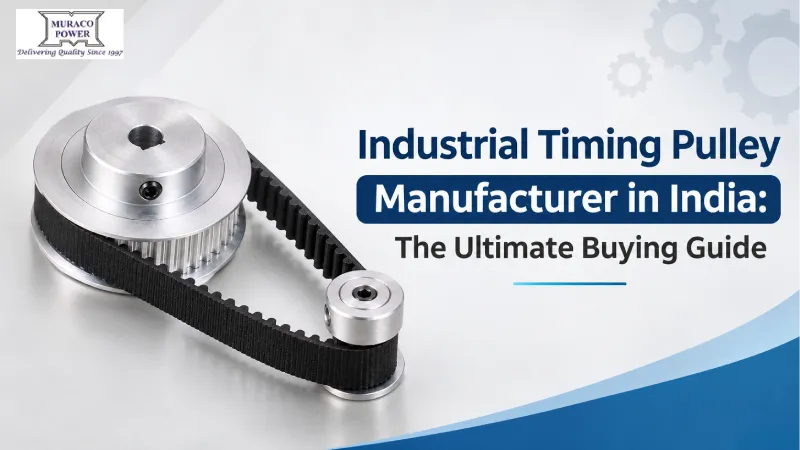
Buying the wrong timing pulley can cause belt mismatch, positioning errors, and unexpected machine downtime. How do you select one that fits your existing drive system? At Muratech Engineering, we manufacture timing belt pulleys in Ahmedabad, Gujarat, with standard and custom configurations. As a Timing Pulley Manufacturer in India, we help industrial buyers identify suitable tooth profiles, materials, and mounting arrangements.
Which Timing Pulley Profile Should You Choose for Your Machine?
The first thing to check is your existing timing belt profile. A pulley with the wrong tooth shape or pitch will not match the belt correctly, even when its diameter appears suitable.
As an Industrial Timing Pulley Manufacturer, we offer several tooth profiles for different power transmission requirements.
| Pulley Profile | Available Pitch | Typical Selection Consideration |
|---|---|---|
| MXL, XL, L, H | 2.032 to 12.7 mm | Imperial timing belt systems |
| T Series | T2.5, T5, T10, T20 | Metric trapezoidal belt drives |
| AT Series | AT3, AT5, AT10, AT20 | Reinforced tooth profile applications |
| HTD Series | 3M, 5M, 8M, 14M | Curvilinear tooth engagement |
| STS Series | S3M, S5M, S8M, S14M | Super Torque Drive systems |
For example, an HTD Timing Pulley uses a rounded tooth profile, while a T-series pulley uses trapezoidal teeth. These profiles are not automatically interchangeable.
Our team recommends checking the belt marking and tooth pitch before choosing any replacement pulley.
How Do You Select the Right Pulley Size and Bore?
A matching tooth profile is only the beginning. Pulley diameter, tooth count, belt width, and shaft mounting also affect whether the component fits your machine.
We produce timing belt pulleys in a wide range of sizes and bore configurations to suit different industrial requirements.
Check these five details before ordering:
- Tooth profile and pitch: Match the pulley with the existing timing belt.
- Number of teeth: Confirm the required drive ratio and pulley dimensions.
- Belt width: Select a pulley face width suitable for the belt.
- Shaft diameter: Verify the required bore size for installation.
- Mounting arrangement: Choose unbored, pilot bore, finished bore, or taper lock options.
Our Custom Timing Pulley manufacturing service also accepts customer drawings and specifications.
For replacement orders, sharing the existing pulley drawing or sample helps our team review the required dimensions before manufacturing.
Which Timing Pulley Material Is Right for Your Application?
Material selection depends on the mechanical load, working environment, and pulley design. Choosing material without checking these factors can lead to an unsuitable component.
Our timing belt pulleys are manufactured using quality materials, including aluminium, mild steel, stainless steel, and cast iron.
- Aluminium: Suitable for applications where lower component weight is preferred.
- Mild Steel: An option for industrial applications requiring steel construction and mechanical strength.
- Stainless Steel: Worth considering when operating conditions require corrosion resistance.
- Cast Iron: Used for selected industrial pulley configurations where its mechanical characteristics suit the application.
Our aluminium timing belt pulleys are also available with zinc-plated steel flanges in specified configurations.
During Timing Pulley Selection, buyers should confirm material requirements together with shaft dimensions and belt compatibility rather than selecting only by appearance.
What Should Industrial Buyers Check Before Placing an Order?
A supplier may offer the correct pulley category but still require detailed specifications to manufacture a suitable component.
Our timing belt pulley range covers automotive, textile, packaging, and general engineering applications. We also manufacture synchronous pulleys and timing belt sprockets according to customer drawings.
Please keep the following details ready before submitting your quotation request:
- Existing belt profile and pitch
- Required tooth count and belt width
- Shaft diameter and bore configuration
- Preferred pulley material
- Technical drawing, sample, or special dimensional requirements
We use modern machining equipment and conduct quality checks during production.
For custom orders, our team can review the drawing and discuss suitable manufacturing options before proceeding. This is especially useful when standard catalogue dimensions do not match the equipment.
How Can You Identify a Suitable Timing Pulley Manufacturer in India?
When selecting an Industrial Timing Pulley Manufacturer, look beyond the product name. Check whether the supplier offers your required tooth profile, material, bore configuration, and custom manufacturing options.
Our Ahmedabad facility manufactures classical, metric, HTD, and Super Torque timing pulleys in different configurations.
We also offer pilot bore, finished bore, and taper lock mounting options. For industrial buyers, this range makes it easier to discuss both replacement requirements and new machinery designs with one manufacturing team.
Why Choose Muratech Engineering?
At Muratech Engineering, we manufacture timing belt pulleys for industrial power transmission requirements from Ahmedabad, Gujarat. Our ISO 9001:2015 and ISO 45001:2018 certifications reflect our stated management systems. We offer multiple tooth profiles, material choices, and custom manufacturing based on customer drawings, helping buyers source pulleys that match their specific machinery requirements.
Conclusion
The right industrial timing pulley starts with accurate specifications, not guesswork. Tooth profile, pitch, bore size, belt width, and material must match the intended drive system. Working with an experienced Timing Pulley Manufacturer in India gives buyers access to standard configurations and drawing-based manufacturing options. Before ordering, share your technical requirements so our team can review the pulley design and suitable production specifications.
Looking for timing pulleys for industrial machinery? Contact Muratech Engineering for standard or custom pulley manufacturing enquiries.
Call: +91 9510656161
Email: info@applcontainers.com