Helical Gear Manufacturer in Ahmedabad

Sprockets and gears
Angled teeth for quieter, stronger drives
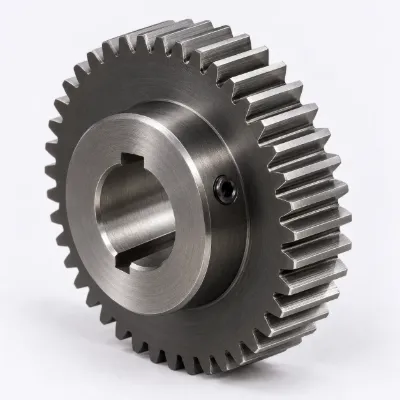
Single and double helical gears and pinions, module 0.5 to 10, up to 15 in diameter, in EN series steels, mild steel, stainless steel, cast iron, Delrin and nylon. Gears and pinions machined to your drawing, quieter and stronger than spur gears at speed.
Helical gears have teeth cut at an angle to the shaft. Each tooth engages gradually, and more teeth share the load at once, so helical gears run quieter and carry more load than spur gears of the same size, especially at speed.
The angled teeth create an axial thrust, which the bearings must take. Double helical gears, with two opposite hands side by side, cancel that thrust. For simpler, slower drives, see our spur gears.
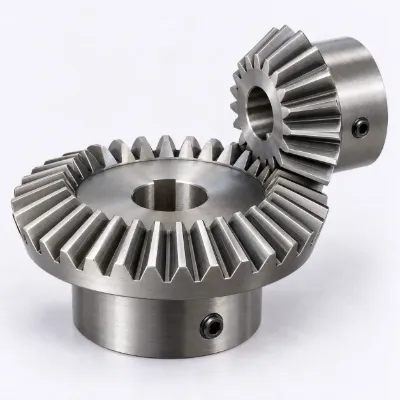
Helical gears can transfer motion between parallel or non parallel shafts. On parallel shafts, one gear of the pair is right handed and the other left handed. On shafts at a right angle, both gears have the same hand, and the pair is often called spiral gears. Because the load is spread across more of the tooth, a smaller helical gear can often handle the same torque as a larger spur gear.
A larger helix angle gives smoother running but more axial thrust. Where thrust is a problem, double helical (herringbone) gears balance it, whether made in one piece or as two matched halves with a small centre groove. We make helical gears in a wide variety of sizes and finishes, for conveyors, automotive parts and heavy duty machinery.
- Since 1997
- Made to drawing
- Made in Ahmedabad
Download the gear cataloguePDF, 8 pages, 3.0 MB
At a glance
- Types
- Single helical, double helical (herringbone), pinions
- Module
- 0.5 to 10 (DP 50.8 to 2.54)
- Diameter
- Up to 15 in
- Helix
- Left or right hand, angle to your drawing
- Cutting
- Hobbing, shaping, milling, grinding
- Heat treatment
- Carburising or nitriding to the required hardness
Capability
Helical gear specifications: module, helix angle, face width
Involute helical teeth
Helical gear capability
Machined from solid round bar.
| Parameter | Range |
|---|---|
| Module | 0.5 to 10 |
| Diametral pitch | 50.8 to 2.54 |
| Diameter | Up to 15 in |
| Face width | Up to 15 in |
| Helix angle and hand | To your drawing, left or right hand |
| Types | Single helical, double helical (one piece or two matched halves) |
| Gear cutting | Hobbing, shaping, milling, grinding |
| Heat treatment | Carburising or nitriding to the required HRC |
| Surface finish | Black oxide, zinc or chrome plating |
| Final finishing | Grinding or lapping |
| Shaft features | Flat or hexagonal |
| Production | Prototype, small and large runs |
| Typical industries | Automotive, pharmaceuticals, packaging, paper, machinery, construction, marine, chemicals, food processing |
Choosing a gear
Helical or spur: choosing the right gear
-
Quieter at speed
Gradual tooth engagement means less noise and vibration.
-
More load per face width
Several teeth share the load at any moment.
-
Axial thrust
Single helical gears push along the shaft, so the bearings must take thrust.
-
When spur wins
For slow, simple drives, spur gears are easier and more efficient.
Materials
Materials and heat treatment
-
Aluminium
Light with low inertia, so drives start and stop quickly.
Best for: general machinery
-
Mild steel
Tough and economical, machined from bar for most industrial parts.
Best for: general duty
-
EN series steels
Carbon and alloy steels, hardened where needed for high torque and wear.
Best for: high load
-
Stainless steel
Resists corrosion where machines are washed down or run wet.
Best for: food and pharma
-
Cast iron
Stable and economical for large diameter, heavy duty parts.
Best for: large diameters
-
Delrin and nylon
Quiet and light, with no lubrication needed.
Best for: light, quiet drives
Benefits
Features and benefits of helical gears
-
Continuous power transmission
Several teeth engage at the same time, so power passes smoothly and without sudden shock.
-
Suited to high speed
Less noise and vibration than spur gears makes them a good fit for high speed and heavy duty use.
-
High load capacity
Better load distribution across the teeth suits heavy duty applications and long working hours.
-
Flexible shaft layouts
Work with parallel or non parallel shafts, giving more freedom in machine design.
-
Efficient at high ratios
Provide high gear ratios with good transmission efficiency, for machines and automotive systems.
-
Helix angle to suit
The angle is set to your drawing, balancing smooth running against axial thrust on the bearings.
Replacing a gear
Replacement helical gears: what to send
-
Teeth and diameter
Tooth count and outside diameter.
-
Hand and helix angle
Left or right hand, and the helix angle or lead.
-
Face width and bore
Face width, bore, keyway and hub.
-
Mating gear
Its details, or a drawing or sample.
Industries
Where our helical gears run

FAQ
Helical gears: common questions
Quick answers for maintenance and purchase teams.
Helical gears are quieter and carry more load at speed, but create axial thrust. Spur gears are simpler and slightly more efficient, and suit slower drives.
Single helical gears push along the shaft, so the bearings must take that axial thrust. Double helical gears cancel the thrust with two opposite hands.
Yes. We make double helical (herringbone) gears in one piece or as two matched halves with a centre groove.
Send the tooth counts, outside diameters, hand and helix angle, face width and bore, or a drawing or sample of the old pair.
Aluminium, mild steel, stainless steel, cast iron, Delrin, nylon and EN series steels. Aluminium suits light, fast drives, mild steel and EN series steels suit high torque and wear, stainless steel suits washdown areas, cast iron suits large heavy parts, and Delrin or nylon suit light, quiet drives.