Key Takeaways
- Helical gears provide smoother operation and reduced noise compared to spur gears due to their gradual tooth engagement.
- As a leading Helical Gear Manufacturer in India, Muratech Engineering offers customized gear solutions for diverse industrial applications.
- Choosing the right helical gear involves assessing gear dimensions, materials, and operating conditions to prevent premature wear.
- Proper bearing support is crucial when using helical gears, as they generate axial thrust during operation.
- Muratech Engineering specializes in manufacturing helical gears for heavy-duty applications, helping improve machinery performance.
Does your industrial machinery produce excessive gear noise, vibration, or inconsistent power transmission? The problem may lie in gear selection rather than the entire drive system.
At Muratech Engineering, we manufacture helical gears for industrial machinery that requires smooth movement and reliable load handling. As a Helical Gear Manufacturer in India, we offer different materials, gear sizes, and manufacturing options to match specific operating requirements.
Why Do Helical Gears Run Smoother Than Spur Gears?
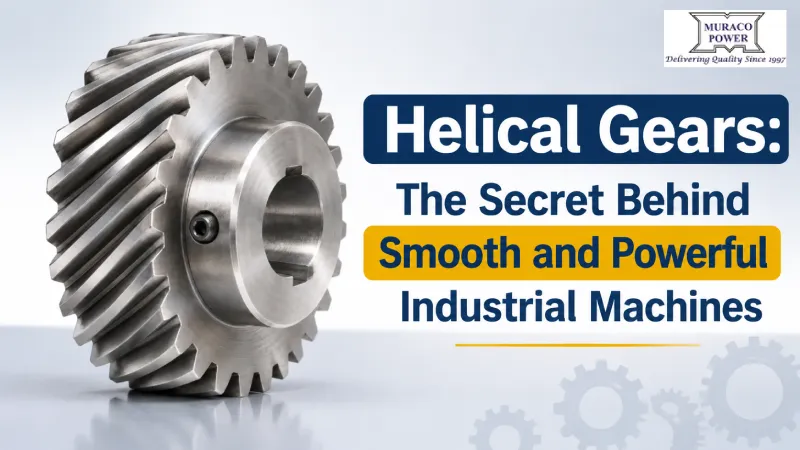
The biggest difference lies in how the teeth engage. Spur gears have straight teeth that contact suddenly, while helical gears use angled teeth that engage gradually.
This progressive contact distributes loads across the teeth and reduces vibration during operation. Multiple teeth can share the load, making helical gears suitable for high-speed and heavy-duty applications.
Our industrial helical gears are manufactured for parallel and selected non-parallel shaft arrangements. For parallel shafts, mating gears use opposite helix directions.
However, helical gears generate axial thrust during operation. Buyers must consider suitable bearings and shaft support rather than selecting gears based only on noise reduction.
We also manufacture double helical or herringbone gears, which use opposing tooth directions to balance axial thrust.
What Makes Helical Gears Suitable for Heavy Industrial Loads?
When machines operate under continuous loads, tooth geometry and material selection directly affect gear performance.
Our Helical Gear Manufacturer team offers gears with the following manufacturing capabilities:
- Diameter: Up to 15 inches
- Module: 0.5 to 10
- Face width: Up to 15 inches
- Production volume: Prototypes and small-to-large production runs
- Gear cutting: Hobbing, shaping, milling, and grinding
- Heat treatment: Carburizing or nitriding according to hardness requirements
These specifications help machinery manufacturers assess whether our production range matches their design requirements.
We work with alloy steel, carbon steel, brass, cast iron, polycarbonate, Delrin plastic, and cast nylon. Material selection depends on operating loads, wear requirements, and the intended machinery application.
Where Are Helical Gears Used in Modern Industrial Machinery?
Different industries require different gear arrangements. Some prioritize quieter operation, while others need effective power transmission under repeated loads.
Our helical gear applications include machinery requirements across these sectors:
- Automotive Industry : Helical gears support smooth power transmission in suitable automotive gear assemblies. Their gradual tooth engagement helps reduce operating noise.
- Conveyor Systems : Industrial conveyors need controlled rotational power for material movement. Helical gear arrangements can handle continuous drive requirements where the selected gear specifications match operating conditions.
- Packaging Machinery : Packaging machines perform repeated mechanical movements. Properly selected helical gears help reduce vibration in suitable drive assemblies.
- Paper Industry : Paper-processing machinery uses rotating mechanical components that require dependable power transfer. Helical gears support continuous operation in appropriate transmission arrangements.
- Construction Machinery : Construction equipment may experience demanding mechanical loads. Helical gears offer useful load-sharing characteristics for suitable heavy-duty drive systems.
- Pharmaceutical and Food Processing Machinery : These industries use mechanically driven equipment requiring controlled motion. Gear material, operating load, and installation requirements must be assessed for each machine.
As a Helical Gear Manufacturer in Ahmedabad, we manufacture gears in different dimensions and material options for industrial applications.
How Should Buyers Select the Right Helical Gear?
Selecting a gear without checking the operating requirements can lead to excessive wear, vibration, or premature component damage.
Before placing an order, buyers should confirm these specifications:
- Gear module and diameter: Check compatibility with the existing gear assembly.
- Helix angle and direction: Match the required tooth geometry and shaft arrangement.
- Operating load and speed: Identify the torque and rotational speed the gear must handle.
- Material: Select a suitable metal or engineering plastic based on working conditions.
- Shaft and bearing support: Account for the axial thrust generated by helical gears.
- Finishing requirements: Identify whether grinding, lapping, or specific heat treatment is required.
Our team offers custom helical gears with different manufacturing and finishing options. Sharing accurate technical drawings helps us understand the required gear configuration.
Can Manufacturing Quality Affect Helical Gear Performance?
Even a suitable gear design depends on accurate manufacturing. Tooth geometry, finishing, and material processing influence how the mating gears engage.
Our manufacturing methods include gear hobbing, shaping, milling, grinding, and EDM. We also offer carburizing, nitriding, black oxide finishing, and selected plating processes.
Grinding or lapping can be used for final finishing according to component requirements.
Buyers working with a Helical Gear Manufacturer in India should confirm production capabilities against their drawings instead of relying only on general gear descriptions.
Why Choose Muratech Engineering?
At Muratech Engineering, we have manufactured mechanical power transmission products since 1997. Based in Ahmedabad, Gujarat, we offer single and double helical gears in multiple materials and sizes. Our production capabilities cover prototypes through larger manufacturing runs, with machining, heat treatment, and finishing options available for different industrial gear requirements.
Conclusion
Smooth power transmission starts with choosing gears that match the machine's actual operating conditions. Helical gears offer gradual tooth engagement, effective load distribution, and quieter operation than comparable spur gears. However, proper material selection, shaft support, and dimensional accuracy remain essential. Our team helps industrial buyers evaluate these requirements through available gear manufacturing options, supporting informed component selection for modern machinery.
Looking for a dependable Helical Gear Manufacturer for your machinery requirements? Contact Muratech Engineering and discuss your gear drawings, dimensions, and material specifications with our team.
Call: +91 9510656161
Email: info@applcontainers.com