
Table of Contents
- Introduction
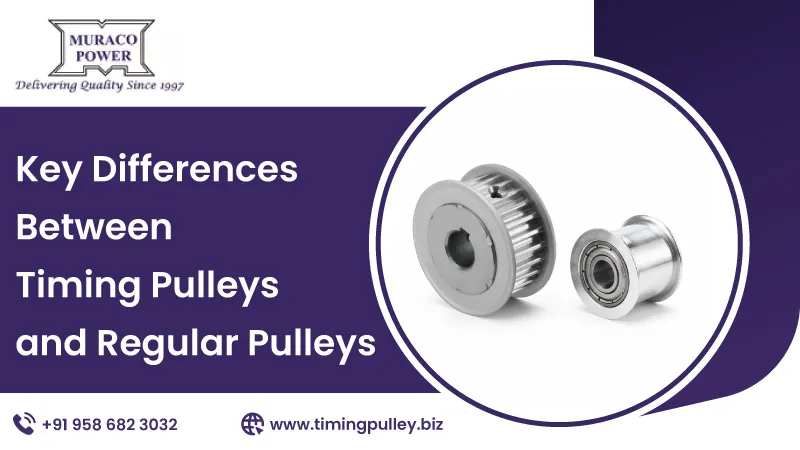
What keeps a machine running smooth, silent, and accurate even after thousands of cycles? The answer often comes down to one small but critical component. The pulley. Many buyers treat all pulleys as the same. That one decision later turns into vibration, slip, noise, and costly downtime. If you work with power transmission systems, you already know how much depends on choosing the right pulley. This guide explains the real and practical differences between timing pulley systems and regular pulley systems. You will learn where each one fits, how performance changes, and how to select the right option for your application.
Muratech Engineering works daily with factories that use industrial timing pulley systems, v belt pulley drives, taper lock bush & qd bush pulley assemblies, and even chain sprocket solutions. This experience shapes every section of this guide. If you want fewer breakdowns and better machine output, this article will save you time and money.
Understanding the Basics of Pulley Systems
A pulley is a mechanical part used to transfer power from one shaft to another. It works with a belt or chain to move torque and speed across a distance. The basic idea stays the same, but the design changes everything. A timing pulley uses a toothed belt that locks into matching grooves. This creates positive drive. No slip. No speed loss. The shaft position stays accurate every time.
A regular pulley, such as a v belt pulley, works on friction. The belt grips the pulley surface and transfers motion. This method is simple and low cost but allows some slip, especially under load or during speed changes. Both systems have a role. The mistake is using one where the other is needed.
What Is a Timing Pulley System
A timing pulley is designed with precisely machined teeth. These teeth match the teeth on a timing belt. When the system runs, the belt and pulley move together in fixed steps. This keeps shaft position, speed, and timing accurate. In industries like packaging, printing, CNC machines, automation, and robotics, accuracy is not optional. That is why industrial timing pulley systems are used in these machines.
Muratech Engineering, as a timing pulley manufacturer in India, designs these pulleys for stable performance, long life, and exact fit. Many buyers also prefer working with a timing pulley manufacturer in Ahmedabad because of faster support and customization options.
Key features of a timing pulley system include:
- Zero slip during operation
- Fixed speed ratio
- High positional accuracy
- Stable performance at high speed
- Lower maintenance when aligned correctly
What Is a Regular Pulley System
A regular pulley system usually refers to friction-based drives. The most common example is the v belt pulley. The belt sits in a V-shaped groove and transfers power through grip and tension. Another common power transmission method uses a chain sprocket, where a chain and toothed wheel transfer motion. This also creates positive drive, but the system is heavier and noisier compared to belt-driven solutions.
Regular pulleys work well in many applications like pumps, fans, compressors, and general machinery. They cost less, handle shock loads well and are easy to replace. Many of these systems also use taper lock bush & qd bush pulley designs. These bushes allow easy mounting and removal without damaging the shaft or pulley.
The Core Difference Between Timing Pulleys and Regular Pulleys
The real difference comes down to control and precision. A timing pulley controls motion. A regular pulley transfers motion. With a timing pulley, the shaft always stays in the correct position relative to the drive shaft. With a v belt pulley, the belt can slip slightly. That slip changes speed and position over time.
This difference matters a lot in machines where:
- Position must repeat exactly
- Speed must stay constant
- Multiple shafts must stay synchronized
In such cases, industrial timing pulley systems become the only practical solution.
Power Transmission Accuracy and Speed Control
Accuracy is the biggest advantage of a timing pulley. Because the belt teeth lock into the pulley grooves, the speed ratio stays fixed. If the motor turns one full rotation, the driven shaft turns exactly the calculated amount. This stays true even after long hours of use. With a v belt pulley, speed depends on friction. As the belt wears, stretches, or heats up, slip increases. This changes output speed. In simple machines, this does not matter. In precision machines, it causes product defects and alignment problems. That is why a timing pulley manufacturer focuses so much on tooth profile accuracy and surface finish.
Load Handling and Torque Capacity
Both systems can handle high loads, but they do it in different ways. A v belt pulley spreads the load across the belt surface. It also absorbs shock well. This makes it suitable for heavy machines with uneven loads. A timing pulley transfers load through the teeth. This gives very efficient power transfer but requires proper design. If the pulley or belt is undersized, tooth wear increases.
A good timing pulley manufacturer in India will always calculate load, speed, and service factor before suggesting a pulley size. For extremely heavy and slow-speed applications, many engineers still choose a chain sprocket system. Chains handle very high torque but create more noise and need lubrication.
Noise, Vibration, and Smoothness
Noise and vibration affect machine life and operator comfort. A timing pulley system runs smoother and quieter than a chain sprocket system. Compared to a v belt pulley, it also keeps speed more stable, which reduces vibration in precision equipment. However, tooth profile and alignment matter a lot. Poor quality pulleys or wrong installation can increase noise. That is why working with Muratech Engineering, a trusted timing pulley manufacturer in ahmedabad, gives you an advantage. Precision machining and correct tooth design reduce these issues.
Maintenance and Service Life
Maintenance cost is not just about part price. It is about downtime and replacement frequency. A timing pulley system does not need re-tensioning as often as a v belt pulley system. It also does not suffer from gradual slip. Once installed correctly, it keeps working in a predictable way. A v belt pulley needs regular tension checks. If the belt becomes loose, slip increases. If it is too tight, bearing load increases. Systems that use taper lock bush & qd bush pulley designs make maintenance easier. You can remove or replace pulleys without hammering or heating, which protects shafts and saves time.
Efficiency and Energy Savings
Efficiency affects power cost over time. A timing pulley system transfers power with very high efficiency because there is no slip. Almost all motor power reaches the driven shaft. A v belt pulley loses some energy to heat and friction. The loss is small in each cycle but adds up over months of operation. In factories running multiple machines 24 hours a day, this difference becomes visible in power bills.
Installation and Alignment Requirements
A timing pulley system needs accurate alignment. If the pulleys are not aligned, the belt wears faster and noise increases. A v belt pulley system is more forgiving. It can tolerate small alignment errors without immediate failure. This does not mean timing systems are difficult. It simply means they must be installed carefully, which any trained technician can do.Using taper lock and QD bush pulleys helps you install and align the system faster with better accuracy.
Where Timing Pulleys Are the Best Choice
You should use a timing pulley when:
- You need exact speed and position control
- You run automation or CNC equipment
- You need synchronized shaft movement
- You want stable performance at high speed
- You want predictable maintenance intervals
That is why industrial timing pulley systems appear in packaging lines, printing machines, textile machinery, and assembly automation. Muratech Engineering, as a timing pulley manufacturer, supplies these systems for such applications across many industries.
Where Regular Pulleys Are the Better Choice
You should consider a v belt pulley or chain sprocket system when:
- Load changes suddenly and often
- Precision timing is not critical
- The system must handle shock loads
- You want a low initial cost solution
- Maintenance access is limited
Many pumps, blowers, mixers, and conveyors still work perfectly with regular pulley systems.
The Role of Bush Systems in Both Types
Both timing pulleys and V belt pulleys commonly use taper lock and QD bush mounting systems for secure and reliable fitting.
These bushes:
- Make installation easier
- Protect the shaft from damage
- Improve concentricity
- Allow fast removal and replacement
This small design choice improves reliability and reduces service time.
Manufacturing Quality and Its Impact
Not all pulleys perform the same. Tooth accuracy, material quality, surface finish, and balance all affect performance. A poorly made timing pulley can destroy a belt quickly. A poorly balanced v belt pulley can damage bearings. That is why working with Muratech Engineering, a trusted timing pulley manufacturer in India, gives you better results. The company focuses on machining accuracy, inspection, and proper material selection. Working with a timing pulley manufacturer in ahmedabad also helps many buyers get faster delivery and technical support.
How to Select the Best System for Your Machine
Ask these questions:
- Does my machine need precise positioning
- Does speed ratio need to stay exact
- What load and speed will the system run
- How important is maintenance cost
- How critical is downtime
If accuracy and repeatability matter, choose a timing pulley. If simplicity and shock load handling matter more, choose a v belt pulley or chain sprocket system. A good supplier will always ask these questions before suggesting a product.
Why Choose Muratech Engineering
Muratech Engineering stands out because the company does not sell parts. It provides working solutions. As a trusted timing pulley manufacturer, Muratech Engineering focuses on accuracy, fit, and long service life. The team has strong knowledge of how timing pulleys, V belt drives, taper lock and QD bush assemblies, and chain sprocket systems work in real industrial machines. This practical experience helps customers avoid wrong selection and repeated failures. Being a recognized timing pulley manufacturer in india and a reliable timing pulley manufacturer in ahmedabad, the company supports customers with consistent quality, technical guidance, and dependable delivery. Muratech Engineering builds long-term partnerships, not just supplies products.
Conclusion
Choosing between a timing pulley and a regular pulley is not about price. It is about performance, accuracy, and long-term stability. Timing systems give precise control, stable speed, and predictable output. Regular pulley systems offer flexibility, shock absorption, and lower initial cost. Both have a clear role in modern machinery. The real success comes from matching the system to the application. With the right guidance and quality components from Muratech Engineering, you avoid downtime, reduce maintenance issues, and get consistent machine performance. Smart selection today saves cost, time, and stress for many years.
For expert guidance on timing pulleys and power transmission solutions, contact Muratech Engineering today. Call +91 958-682-3032 or email muracopower@hotmail.com to discuss your application needs.
Key Takeaways
- A timing pulley gives exact speed and position control with zero slip.
- A v belt pulley works well for simple, shock load applications.
- Industrial timing pulley systems suit automation and precision machines.
- Taper lock bush & qd bush pulley designs reduce installation and service time.
- Choosing the right timing pulley manufacturer in India improves machine reliability.