
| We Offer | |
|---|---|
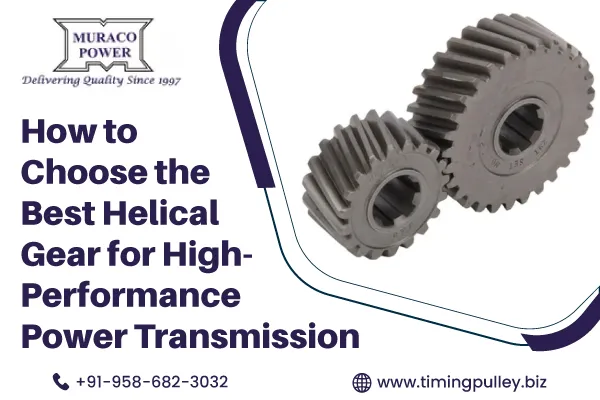
| How to Choose the Best Helical Gear for High-Performance Power Transmission | |
| Call Now | +91-958-682-3032 |
| +91-958-682-3032 | |
| Eligible Region | India |
| Category | Helical Gear |
| Payment Methods | Cash, UPI, Net Banking |
In high-power mechanical systems, selecting the right transmission components can make or break performance. When you want smooth torque delivery, quiet operation, and longevity in demanding environments, helical gears stand out. But not all helical gears are created equal. Choosing the best helical gear for power transmission requires a detailed understanding of materials, manufacturing approaches, load conditions, and application-specific nuances. As a leading helical gear manufacturer in India, Muratech Engineering Company brings decades of engineering expertise to help you make the right decision. In this blog, we present a comprehensive helical gear selection guide that empowers design engineers, maintenance managers, and procurement teams to invest wisely for reliability and efficiency.
Why Helical Gears Matter in High-Performance Power Transmission
Helical gears are a mainstay in power transmission due to their helical (angled) teeth, which offer several advantages over simpler gear types. The angled teeth engage gradually rather than all at once, lowering shock loads and producing smoother motion. This design characteristic helps distribute load over several teeth, reducing wear and increasing torque capacity.
Key Features of High-Performance Helical Gears
To pick the right gear, understanding the features that differentiate high-quality performance gears is essential. Below are the primary aspects to consider:
- Load Capacity and Torque Ratings: High-performance helical gears are designed to handle high torque. Their load capacity depends on tooth geometry, material strength, and heat-treatment processes. Designers need to check the gear’s specification chart for allowable torque, bending stress, and contact stress.
- Pitch and Module: The module (or diametral pitch in imperial units) influences how much load a gear tooth can carry. A finer module gives smoother operation but may not bear as much load. Coarser modules can handle more load but may generate more noise. Matching the module to your system’s speed and torque profile is part of the helical gear selection guide.
- Helix Angle: The helix angle is critical: higher angles improve load sharing but generate higher thrust forces along the axis of the shaft. Designers must balance helix angle with bearing selection and axial load capacity.
- Face Width: Wider face widths distribute load across a larger surface, improving durability. But increasing face width raises inertia and may have design trade-offs. High-performance gears often use optimized face widths for the best compromise.
- Surface Finish and Tooth Accuracy: Precision ground or hobbed teeth reduce noise and vibration. Surface finish improves contact and reduces friction losses. High-accuracy gears (e.g., quality class 5 or better) are often necessary for high-speed or sensitive applications.
- Heat Treatment: Gears might be carburized, nitrided, induction-hardened, or through-hardened. These treatments boost gear strength, wear resistance, and fatigue life. Selecting the right heat-treatment process is a must in any serious helical gear selection guide.
- Lubrication and Coating: High-quality helical gears often require specific lubricants and sometimes surface coatings (like phosphate, PVD, or specialty coatings) to reduce wear and corrosion. These factors directly influence gear life and reliability.
Helical Gear Selection Guide: Step-by-Step Criteria
This section provides a fully detailed helical gear selection guide to help you pick the ideal gear for demanding power transmission systems.
- Define Application Requirements
- Power and Speed: Calculate peak torque, average torque, and rotational speeds.
- Loads: Determine whether the load is constant, cyclic, shock-based, or pulsating.
- Space Constraints: Consider the available space for gear installation, including face width, shaft diameters, and bearing positions.
- Alignment: Identify misalignment tolerances. Helical gears can accommodate some misalignment but must be supported correctly.
- Operating Environment: Assess temperature, humidity, dust, or chemical exposure. These environmental factors influence material and lubrication choices.
- Determine Gear Geometry
- Select the module (metric) or pitch (imperial) based on torque and speed.
- Choose the helix angle: typically between 15°–30°, balancing load sharing and axial thrust.
- Determine face width required for load distribution and lifespan.
- Specify whether the gear should be single helical or double helical (herringbone), depending on axial force handling and space constraints.
- Material and Heat-Treatment Selection
- For heavy-duty use, materials like alloy steel (e.g., 16MnCr5, 20CrMo) are common.
- Choose a heat-treatment:
- Carburizing for high surface hardness and fatigue strength.
- Nitriding for wear resistance and core toughness.
- Induction hardening for selective hardening of tooth flanks.
- Verify that the selected high-performance helical gears have the proper metallurgy to match your load conditions.
- Accuracy and Quality Grade
- Opt for gear quality classes consistent with the application (e.g., ISO Grade 5–8 for power transmission).
- For noise-sensitive or high-speed systems, finer tolerances and precision grinding will pay off.
- Lubrication Strategy
- Choose a lubricant with the right viscosity, EP (extreme pressure) additives, and thermal stability.
- Consider whether splash lubrication, forced circulation, or oil bath is appropriate.
- If the application demands, explore specialty coatings for the gears to reduce friction or protect from corrosion.
- Bearing and Shaft Support
- Estimate axial thrust from helix angle to select suitable bearings.
- Check whether shafts can withstand bending moments from the gear load.
- Confirm mounting tolerances and assembly practices for long-term alignment.
- Noise, Vibration, and Efficiency
- Use the helical gear selection guide to balance helix angle, face width, and tooth accuracy to minimize NVH (noise, vibration, and harshness).
- Simulation tools (like FEA or gear design software) can help predict meshing behavior.
- Testing and Validation
- Specify prototype testing if required (load testing, life testing, thermal testing).
- Define inspection criteria: tooth contact pattern (e.g., via dye check), run-out, backlash, and dynamic behavior.
- Consider acquiring gears from a helical gear manufacturer in India with rigorous quality assurance processes like those followed by Muratech Engineering Company.
Why Choose Us
When you choose Muratech Engineering Company, you partner with a dedicated helical gear manufacturer in India that combines deep engineering heritage with rigorous quality systems. We deliver reliability under the toughest loads, support your engineering team with expert guidance, and provide personalized service to match your precise power-transmission needs. Over years of collaboration, we have built trust by standing behind our products with transparent documentation, consistent performance, and a genuine commitment to our clients’ success.
Conclusion
Selecting the right helical gear for high-performance power transmission is a complex but critical decision. By following this comprehensive helical gear selection guide, you can evaluate geometry, materials, manufacturing, and quality in a structured way. Coupled with smart helical gear buying tips, you can secure gears that deliver longevity, efficiency, and silent operation. With Muratech Engineering Company’s expertise and proven track record in manufacturing, you are well-positioned to optimize your power-transmission system for peak performance.
Call +91-958-682-3032 or email muracopower@hotmail.com to explore how our tailored gear solutions can meet your exact requirements.